
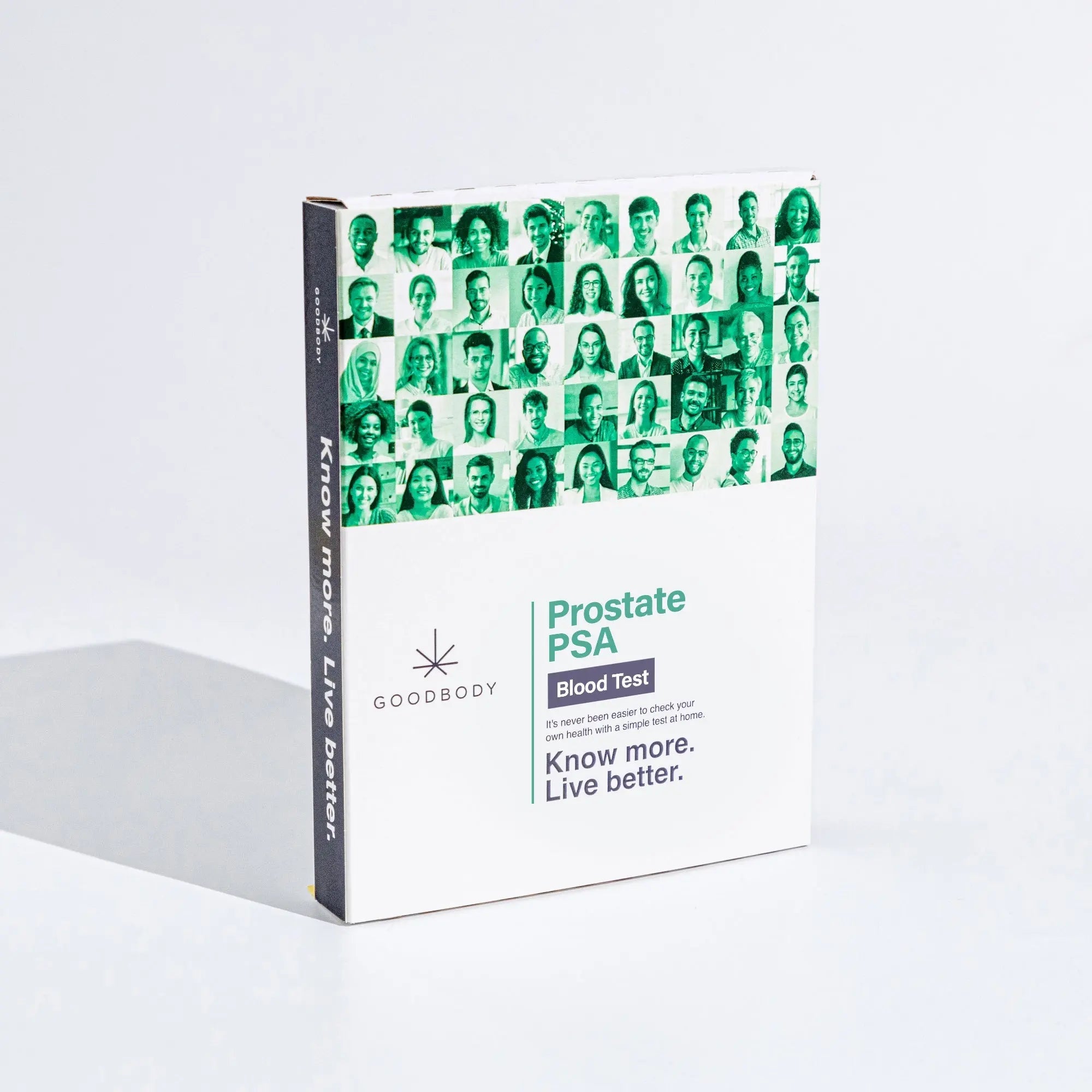
Quick answer: The PSA test is the standard first check for prostate cancer. It's cheap and quick, but it often gives raised results in men who don't have cancer. Stockholm3 combines PSA with other proteins, genetic markers and your health details to give a more specific risk score, backed by a large Swedish screening study. EpiSwitch PSE adds a newer type of blood-based (systemic epigenetic) marker to your PSA result to estimate the likelihood that prostate cancer is present; early results are promising but come from smaller validation and clinical utility studies. None of them can diagnose cancer on their own: a raised result leads to an MRI scan and, if needed, a biopsy.
The three tests at a glance
| PSA | Stockholm3 | EpiSwitch PSE | |
|---|---|---|---|
| What it measures | PSA, a protein made by the prostate | Five blood proteins including PSA, more than 100 genetic markers, plus your age, family history and any past biopsy | Five epigenetic markers in immune cells, read together with your PSA |
| Result | A PSA level, flagged against the laboratory's range | A personal risk score for aggressive prostate cancer | Low or high likelihood of prostate cancer |
| Strength of evidence | Long-standing standard; well known to give false alarms | Large population screening study (Sweden, 2015) | Smaller studies: UK validation (2023) and US clinical utility (2025); larger independent studies still needed |
| Sample | Home finger-prick kit, clinic or home nurse | Clinic blood draw only | Clinic, home nurse or your own collection; needs a PSA result from the last 6 months |
| Results | 3 to 5 working days | Up to 14 working days | 5 working days |
| Goodbody price | PSA test: from £69 | Stockholm3: £595 | EpiSwitch PSE: from £729 |
On a phone, swipe the table sideways to see all three tests.
PSA: the starting point
PSA is the test your GP would use first. It's useful because a normal result is reassuring for most men. Its weakness is that PSA also rises with an enlarged prostate, infection, recent ejaculation or cycling, so most men with a raised PSA turn out not to have cancer. That leads to worry, extra tests and sometimes unnecessary biopsies.
Men over 50 can ask their GP for a free PSA test on the NHS after talking through its pros and cons. You can also have a private PSA test with Goodbody Clinic, at a clinic or with a home finger-prick kit.
Stockholm3: a more specific risk score
Stockholm3 was developed in Sweden to reduce PSA's false alarms. It was tested in the STHLM3 study, which invited men aged 50 to 69 from the general population.
In that study, Stockholm3 picked out significant prostate cancer more accurately than PSA alone. At the same level of cancer detection as a PSA cut-off of 3, using Stockholm3 could have reduced the number of biopsies by 32% and avoided 44% of biopsies that found no cancer.
It's suited to men aged 45 to 74 who want screening, including men whose PSA is normal or borderline, or who have a family history of prostate cancer. The Stockholm3 needs a blood draw at a clinic.
EpiSwitch PSE: a newer approach
EpiSwitch PSE looks at how DNA is folded inside immune cells in the blood (systemic epigenetic markers), and combines five of these markers with your PSA level. It's designed as a "reflex" test: used after a raised PSA or an abnormal prostate examination, to help decide whether an MRI scan or biopsy is needed.
The main validation study (2023) used blood samples from 109 men in the UK PROSTAGRAM screening study and 38 other patients and controls. In the group used to check the test, a "high likelihood" result was right 92% of the time, and a "low likelihood" result was right 94% of the time. A 2025 study of 187 men at US urology clinics estimated that up to 79% of those with a low-likelihood result could have safely put off a biopsy, though most of these men didn't have a biopsy to confirm it. Both studies were carried out by researchers working with Oxford BioDynamics, which makes the test, and the authors say larger, independent studies are the next step.
Interests to declare: Dr Alexandre Akoulitchev, Goodbody Clinic's Clinical Support Advisor, co-founded Oxford BioDynamics, which developed the EpiSwitch tests, and holds an interest in the company.
Which test should I choose?
- You've never been tested: start with a PSA test. It's the standard, and a normal result is reassuring for most men.
- You want the most evidence-backed screening: Stockholm3 has the strongest evidence of the three for reducing false alarms.
- Your PSA is raised and you're deciding what to do next: speak to your GP first. Stockholm3 or EpiSwitch PSE can add information, but an MRI scan is the standard next step on the NHS.
- You have symptoms, such as needing to pee more often, a weak flow, or blood in your urine or semen: see your GP rather than relying on a screening test.
None of these tests are for men who have already been diagnosed with or treated for prostate cancer.
Frequently asked questions
Is Stockholm3 better than PSA? In the large Swedish study it was more accurate than PSA alone at picking out significant prostate cancer, and could have avoided many unnecessary biopsies. It costs more and takes longer, so many men start with PSA.
Is the EpiSwitch PSE test accurate? Early results are promising, but they come from smaller studies, with more results to follow. It's designed as a reflex test, used after possible signs of prostate cancer such as a raised PSA or an abnormal prostate examination. Larger studies would be needed before it could be used as a first-line screening test. Treat it as extra information alongside PSA, not a replacement for MRI.
Can a blood test diagnose prostate cancer? No. These tests estimate your risk or likelihood. Prostate cancer is diagnosed definitively with an MRI scan and a biopsy.
Is Stockholm3 available on the NHS? Not routinely in England. It's available privately, including at Goodbody Clinic.
What happens if my result is high? Your report explains the next step. Usually that's a referral to a urologist for an MRI scan. Your GP can arrange this on the NHS.
Sources
- Grönberg H et al. Prostate cancer screening in men aged 50–69 years (STHLM3). Lancet Oncology, 2015
- Eklund M et al. MRI-targeted or standard biopsy in prostate cancer screening (STHLM3-MRI). New England Journal of Medicine, 2021
- Eldred-Evans D et al. Population-based prostate cancer screening with MRI or ultrasonography: the IP1-PROSTAGRAM study. JAMA Oncology, 2021
- Pchejetski D et al. Circulating chromosome conformation signatures significantly enhance PSA positive predicting value and overall accuracy for prostate cancer detection. Cancers, 2023
- Berghausen J et al. EpiSwitch PSE blood test reduces unnecessary prostate biopsies: a real-world clinical utility study. Cancers, 2025
- NHS: PSA testing and NHS: Prostate cancer
Scientific fact-check: Dr Alexandre Akoulitchev (interest declared above). Prices checked 24 October 2026.